
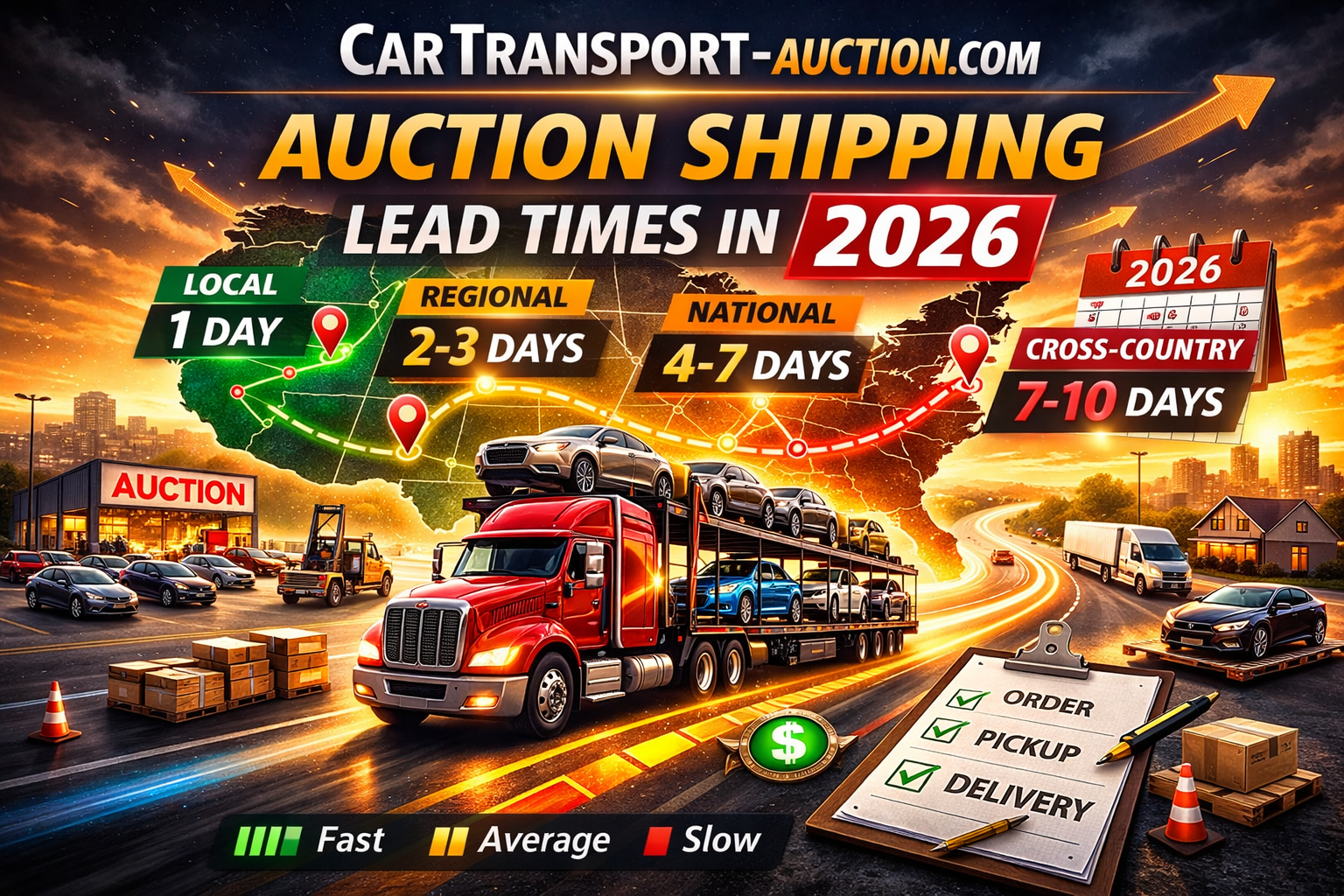
Shipping timelines from auctions in 2026 are becoming more dynamic. While general estimates still exist, actual lead times increasingly depend on market conditions, carrier availability, and route efficiency.
For buyers and small dealers, understanding realistic timelines is essential for planning inventory and avoiding unexpected delays.
What Lead Time Means In Auction Shipping
Lead time is the total duration from booking transport to final delivery.
It includes:
- Dispatch time
- Pickup scheduling
- Transit time
- Delivery coordination
Each stage adds variability to the overall timeline.
Dispatch Time In 2026
Dispatch is often the most unpredictable stage.
Typical ranges:
- Competitive pricing – 1-2 days
- Average pricing – 2-4 days
- Low pricing – 4-7+ days
As demand increases in 2026, dispatch delays are becoming more common.
Pickup Timing At Auction Yards
Once a carrier is assigned, pickup still takes time.
Factors affecting pickup:
- Auction workload
- Queue at the yard
- Vehicle location in storage
- Documentation readiness
Typical pickup window:
- 1-3 days after dispatch
Busy locations may take longer.
Transit Time By Distance
Transit time remains relatively stable compared to other stages.
General estimates:
- 0-500 miles – 1-2 days
- 500-1500 miles – 2-4 days
- 1500+ miles – 4-7 days
However, real timelines depend on route efficiency and load planning.
Delivery Timing And Final Coordination
The final stage is delivery.
Delays can occur due to:
- Scheduling conflicts
- Location accessibility
- Traffic and route conditions
In some cases:
- Delivery may require rescheduling
- Alternate drop-off points may be needed
How Market Conditions Affect Lead Times
Lead times are strongly influenced by market dynamics.
In 2026:
- Demand is increasing
- Carrier capacity is tightening
- Dispatch is becoming slower
This results in longer overall timelines compared to quieter periods.
Regional Differences In Lead Times
Location plays a major role in delivery speed.
Examples:
- Major hubs – faster dispatch and delivery
- Remote areas – longer waiting times
- High-demand states – increased delays
Lead time is not uniform across the country.
Common Causes Of Delays
Several factors can extend shipping timelines.
Most common:
- Low pricing delaying dispatch
- Auction release delays
- High seasonal demand
- Weather conditions
- Route inefficiencies
These factors often overlap.
How To Reduce Lead Times
While you cannot control everything, you can optimize your approach.
Best practices:
- Use realistic pricing
- Book transport immediately after release
- Avoid peak congestion periods
- Be flexible with delivery
- Work with experienced dispatchers
Small improvements can reduce delays significantly.
How Lead Times Fit Into The Full Shipping Process
Lead times are the result of multiple stages working together.
They reflect:
- Dispatch efficiency
- Carrier availability
- Location complexity
- Market demand
Understanding how auction shipping works from start to finish helps explain why timelines vary.
Final Thoughts
Auction shipping lead times in 2026 are becoming more variable as demand increases and market conditions evolve.
While general estimates still apply, flexibility and planning are more important than ever.
Buyers and dealers who understand these timelines can better manage expectations, reduce delays, and keep inventory moving efficiently.